Ozone vs chlorine aquaculture is a critical water treatment decision that directly impacts fish health, biosecurity, production yield, and regulatory compliance across every type of aquaculture operation. Ozone has a higher oxidative strength — 1.52 times more potent than chlorine — and delivers multi-functional water quality benefits, while chlorination is practiced widely in aquaculture for disinfection of holding and rearing tanks for fish due to its low cost and established protocols. This pillar guide gives you the complete, side-by-side comparison: how each disinfectant works, pathogen kill performance, fish toxicity thresholds, disinfection byproduct risks, dosing protocols, application-specific recommendations for RAS, ponds, and hatcheries, compliance requirements, and total cost of ownership.
What Is Ozone vs Chlorine in Aquaculture? Definitions and Core Mechanisms
Ozone and chlorine are both oxidizing agents used to kill pathogens in aquaculture water, but they operate through fundamentally different chemical mechanisms。
How Ozone Works in Aquaculture
Ozone is a triatomic form of oxygen (O₃) with a much higher oxidation potential than molecular oxygen (O₂). It is a naturally unstable gas that readily reacts with organic and inorganic compounds, breaking down complex molecules and inactivating microorganisms。
Bacteria are destroyed by protoplasmic oxidation, which results in cell wall disintegration (cell lysis). This is a critical distinction — ozone physically destroys the cell wall. Ozone is effective against waterborne pathogens and disintegrates bacterial cell walls; chlorine does not do this。
Key ozone characteristics in aquaculture:
- Oxidation potential: 2.07 volts
- Mechanism: Cell wall lysis via protoplasmic oxidation
- Residual: Ozone quickly reverts into pure oxygen if unused。
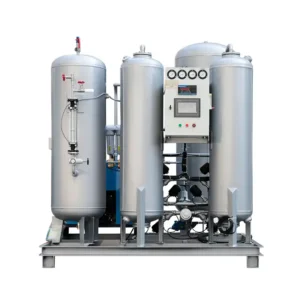
- Generation: On-site production from oxygen and electricity, reducing logistics and chemical handling。
How Chlorine Works in Aquaculture
The active ingredients in chlorination products are chlorine gas, hypochlorous acid (HOCl) and hypochlorite ions (OCl⁻) that result from the dissociation of HOCl. These forms are called free chlorine residuals。
In terms of disinfecting power, chlorine gas and HOCl are about 100 times more potent than OCl⁻. When a chlorination product is applied to water, it dissolves and chlorine speciation occurs based on pH。
Key chlorine characteristics in aquaculture:
- Oxidation potential: 1.36 volts (free chlorine)
- Mechanism: Disrupts cell membrane enzyme activity
- Residual: Persistent — requires active dechlorination before fish contact
- Sources: The three common sources of chlorine are chlorine gas, sodium hypochlorite or household bleach, and calcium hypochlorite, commonly called high-test hypochlorite or HTH。
Ozone vs Chlorine Aquaculture: Core Advantages and Commercial Value
Why Ozone Is Gaining Ground Over Chlorine in Aquaculture
Ozone delivers disinfection plus multi-functional water quality improvement — something chlorine simply cannot match.
| Advantage | Ozone | Chlorine |
|---|---|---|
| Disinfection speed | 3,000 times faster than chlorine | Slow; requires extended contact time |
| Pathogen spectrum | Treats all waterborne pathogens, including those resistant to chlorine, like protozoa, E. coli, and Giardia | Struggles to eliminate certain viruses and protozoa without exceeding safe dosage limits |
| Byproducts | Ozone does not leave a harmful byproduct in water; it breaks down naturally into oxygen (O₂), leaving no toxic residues | Chlorination generates trihalomethanes (THMs), which are disinfection byproducts known to be carcinogenic |
| Water quality improvement | Removes DOC, color, turbidity, nitrite, metals | At concentrations used in aquaculture, chlorine does not cause a significant reduction in organic matter |
| pH dependency | Ozonation remains equally effective across the pH spectrum without altering the water’s pH level | Effectiveness drops significantly at high pH |
| Storage & transport | Generated on-site, eliminating the need for storage and transportation | Requires chemical purchase, transport, and safe storage |
| Growth performance | Rainbow trout grew significantly faster in low exchange RAS operated with ozone compared to trout raised in similarly operated RAS without ozone | No documented growth enhancement |
Where Chlorine Still Holds Value
Chlorine remains a practical choice for specific aquaculture applications:
- Between-crop tank disinfection: An initial cleaning to remove loose debris should be followed by disinfection with a concentrated (~1,600 ppm chlorine) solution of calcium hypochlorite。
- Pond preparation: Chlorine compounds are applied to puddles of water in the bottoms of empty ponds to eliminate wild fish before refilling ponds。
- Low-budget operations: A granular material containing about 65 percent active ingredient, calcium hypochlorite is preferred for aquacultural purposes — and is widely available at low cost。
- Emergency disinfection: Requires no electricity or specialized equipment。
Ozone vs Chlorine Aquaculture: Fish Toxicity and Safety Comparison
Both ozone and chlorine are toxic to fish at residual levels — but their toxicity profiles, thresholds, and management requirements differ significantly。
Chlorine Toxicity to Aquaculture Species
The residual chlorine content of city water (about 1 mg/L) will quickly kill fish。
Residual chlorine is toxic to aquaculture species at concentrations as low as 0.05 ppm for free available chlorine (FAC) and 0.2 ppm for combined available chlorine (CAC)。
Chlorine and chloramines are toxic to fresh and saltwater fish, amphibians, and reptiles. They pass through the gills into the bloodstream, inhibiting the red blood cells‘ ability to carry oxygen. This can lead to severe stress or death in aquatic animals。
Key chlorine toxicity data:
| Species | Lethal Threshold (mg/L TRC) | Source |
|---|---|---|
| Rainbow trout | 0.023 mg/L (96-hr LC50) | Michigan DNR, 1971 |
| Fathead minnow | 0.16–0.21 mg/L (100% kill) | Zillich, 1972 |
| Daphnia magna | 0.017 mg/L (48-hr LC50) | Ward & DeGraeve, 1978 |
| General fish threshold | 0.04–0.05 mg/L | Multiple studies |
Ozone Toxicity to Aquaculture Species
The data corroborate several earlier studies indicating that ≤350 mV is likely the safe ORP threshold value for many farmed fish。
Ozone at 500 mV induced a drastic effect in salmon, resulting in an abrupt, very high single-day mortality 4 days after the start of ozonation。
Both histological and molecular data indicate that the gills were much more sensitive and vulnerable to higher ozone doses than the skin。
Key ozone safety parameters:
- Safe ORP for freshwater RAS: The optimum ORP-Redox level in freshwater RAS is approximately 300 mV, however this value depends on the species。
- Conservative setpoint: When an upper ORP setpoint is reached (typically 300–320 mV), a solenoid valve closes to temporarily suspend ozone addition。
- Feed-based dosing: Ozone doses of 10–15 g/kg feed optimize organic waste reduction while minimizing fish toxicity。
Critical Difference: Residual Management
This is where the ozone vs chlorine aquaculture comparison becomes most consequential for daily operations。
Chlorine residual management:
- Water can be held a few days until the chlorine residuals have dissipated through exposure to light and extraneous reactions。
- It requires about 7 mg/L sodium thiosulfate to remove 1 mg/L free residual chlorine。
- Chloramine poses more difficulties than free chlorine. Activated charcoal used for free chlorine removal is not nearly as effective in removing chloramine。
Ozone residual management:
- Ozone’s half-life in water is 15–30 minutes depending on temperature and organic load。
- Activated carbon or UV irradiation downstream removes residual ozone before fish contact。
- ORP controllers provide real-time, automated safety shutoff。
Ozone vs Chlorine Aquaculture: Application Scenarios and Solutions
Scenario 1: Recirculating Aquaculture Systems (RAS)
Recommended: Ozone. Chlorine is not suitable for continuous RAS water treatment。
Chlorine cannot be used for continuous RAS loop disinfection because it destroys nitrifying bacteria in the biofilter and leaves persistent residuals toxic to fish。
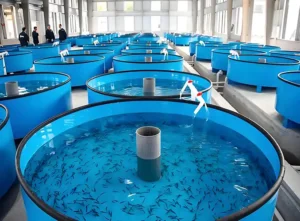
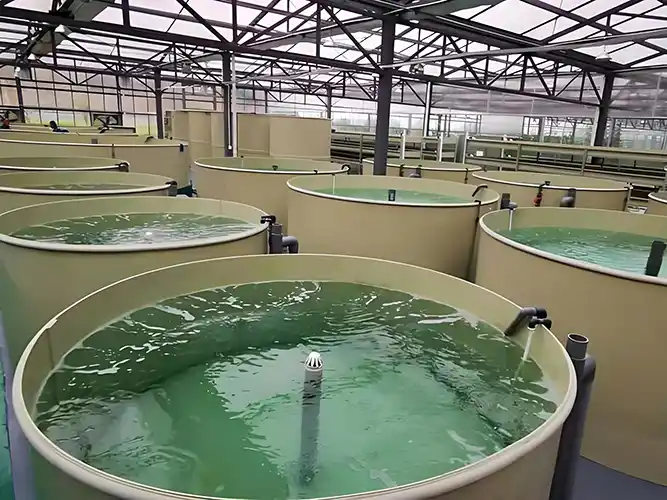
Ozone’s ability to disinfect, control organics, and support better system performance makes it valuable for both RAS and flow-through systems。
In RAS, ozone delivers:
- Organic matter, assessed as chemical oxygen demand, decreased by 25% (low O₃), 30% (middle O₃) and 53% (high O₃), while water transmittance improved by 15% over an 8-day period。
- Atlantic salmon growth was generally faster in ozonated RAS. Salmon from RAS with and without ozone weighed 2,156 ± 101 and 1,810 ± 15 g, respectively, by the end of the study。
Scenario 2: Shrimp Hatcheries and Pond Preparation
Recommended: Chlorine for between-crop disinfection; ozone for continuous water treatment。
In shrimp farming, ozone is increasingly used as a replacement for chlorine, particularly in areas where electricity is cheaper than chemical supply chains。
However, calcium hypochlorite is preferred for aquacultural purposes when performing between-crop pond disinfection. A concentration of 50 mg chlorine/liter is recommended for complete microbial sterilization。
Scenario 3: Intake Water Disinfection (Flow-Through Systems)
Recommended: Either technology works, but ozone provides superior water quality benefits。
Many facilities that draw from water sources containing known pathogens will use ozone to annihilate all harmful microorganisms and break down organics in the water before it enters the facility。
For facilities using municipal water with chlorine/chloramine residuals, dechlorination is mandatory before fish contact. The removal of chlorine from water for aquaculture is commonly achieved through chemical treatment, heavy aeration, activated carbon filters, or UV irradiation。
Scenario 4: Equipment and Facility Disinfection
Recommended: Chlorine. This is where chlorine excels in aquaculture。
The target dose of chlorine for disinfection is 200 mg/L for at least 1 hour. This concentration can be achieved by mixing 0.32 g of the 65% product per liter of water。
A 1-hour contact time at 200 mg/L will destroy most organisms of concern, including most viruses。
Exception: Mycobacteria are refractory to bleach disinfection because of their waxy cell wall。
Ozone vs Chlorine Aquaculture: Implementation and Dosing Guide
How to Implement Ozone in an Aquaculture Facility
Step 1: Select the right ozone generation method。
Ozone generators use oxygen (O₂) to create ozone (O₃). O₃ is a powerful oxidizer that will oxidize any organics it comes in contact with, destroying them. This oxidizing potential makes ozone an effective disinfecting agent。
“Ideal oxygen purity for ozone production is in the 93–96 percent range, which is the operating range for most oxygen concentrators。”
Step 2: Determine proper dosing。
| Application | Ozone Dose | ORP Target |
|---|---|---|
| Water quality enhancement (RAS) | 10–15 g O₃/kg feed | 270–320 mV |
| Disinfection-level dosing | 15–25 g O₃/kg feed | 325–375 mV |
| Intake water sterilization | Depends on pathogen load | Per CT value |
The Redox-ORP probe helped to control ozone generation for maintaining the water quality level between roughly 270 and 290 mV. Armed with the new ozone system, Valperca was able to produce fish at design capacity for the first time。
Step 3: Install safety controls。
- ORP controller with automatic shutoff
- Activated carbon at system outlet
- Stainless steel is highly recommended over plastic piping and fittings because of its high material resistance to oxidation。
- Airborne ozone monitors in the facility
How to Implement Chlorine in Aquaculture Operations
For tank/equipment disinfection (not continuous water treatment):
- Cleaning and disinfection starts with general cleaning and removal of dirt and organic debris. Organic debris, including biofilms, and dirt can shield pathogens from disinfection。
- Apply calcium hypochlorite at 200 mg/L for 1 hour minimum。
- After disinfection with chlorine, small or large tanks should be rinsed with clean water, then filled and flushed to ensure that no chlorine residues remain before the tank is restocked。
- Verify zero residual chlorine with a test kit before introducing fish。
Chlorination usually is applied to provide a free chlorine residual of 1–3 mg/L. The amount of calcium hypochlorite necessary depends upon pH, the abundance of plankton and bacteria, and the concentrations of dissolved and suspended organic matter, ammonia nitrogen, nitrite and other reduced substances。
Ozone vs Chlorine Aquaculture: Industry Compliance and Regulatory Standards
Choosing between ozone and chlorine in aquaculture requires compliance with worker safety, environmental discharge, and food safety regulations。
Chlorine Regulatory Requirements
- EPA Drinking Water Standard: Maximum residual disinfectant level (MRDL) for chlorine is 4.0 mg/L for human consumption — but fish die at 0.04–0.05 mg/L。
- Discharge regulations: Aquaculture water intended to be discharged into natural waters should be disinfected. If chlorination is the system of choice, the dose and treatment duration should be sufficient to kill all pathogenic organisms. However, residual chlorine in effluent must be neutralized before discharge。
- Worker safety: Chlorine is highly toxic to humans and was used in World War I against troops. Chlorine gas is therefore not safe for use at aquaculture facilities. Use only calcium hypochlorite granules or sodium hypochlorite liquid。
- THM/DBP compliance: Trihalomethanes (THMs) and haloacetic acids (HAAs) are commonly associated with chlorine disinfection. EPA regulates THMs at 80 µg/L in drinking water。
Ozone Regulatory Requirements
- OSHA PEL: Exposure standards for residual ozone range between 0.05 and 0.1 ppm for an 8-hour work period and a maximum single dosage of 0.3 ppm for less than 10 minutes。
- Seawater byproduct risk: Both chlorine and ozone produce long-lived residual oxidant compounds in seawater. Seawater at 35 parts per thousand salinity contains 60 ppm bromide ion, which produces hypobromite in the presence of ozone。
- EPA bromate limit: 10 µg/L in drinking water — use as a benchmark for discharge。
- FDA/GRAS status: Ozone is recognized as Generally Recognized as Safe (GRAS) for food contact applications by the FDA。
- WOAH (OIE) guidelines: Residual compounds are toxic to aquatic animals such as larval oysters; treated seawater must be passed through an activated charcoal filter before being used for live organisms。
Compliance Comparison Summary
| Requirement | Ozone | Chlorine |
|---|---|---|
| Worker safety complexity | Moderate (airborne monitoring needed) | High (chemical handling, storage, spill risk) |
| Environmental discharge | Low risk (reverts to O₂) | High risk (residual chlorine toxic to receiving waters) |
| Disinfection byproducts | Bromates in saltwater only | THMs, HAAs in all water types |
| Chemical storage regs | None (generated on-site) | Hazmat storage requirements apply |
| Food safety status | FDA GRAS approved | Requires complete residual removal |
5 Critical Decision Mistakes in the Ozone vs Chlorine Aquaculture Choice
Mistake #1: Using Chlorine for Continuous RAS Water Treatment
Some facility operators attempt to use low-dose chlorination for ongoing RAS pathogen control. This destroys the nitrifying bacteria in the biofilter, causes ammonia and nitrite spikes, and creates persistent residual toxicity。
Fix: Use ozone for continuous RAS treatment. Reserve chlorine exclusively for between-crop tank and equipment disinfection。
Mistake #2: Ignoring Chloramine Formation in Aquaculture Water
Chlorine species also react with ammonia to form chloramines that have less disinfecting power than free chlorine residuals. In aquaculture water with elevated ammonia, chlorine dosing creates chloramines that are harder to remove and persistently toxic。
Fix: Test for both free and combined chlorine residuals. Use catalytic activated carbon or sodium thiosulfate + zeolite for chloramine removal。
Mistake #3: Assuming Chlorine Reduces Organic Load
Some farmers think that chlorination of water or bottom soil reduces organic matter concentrations. Although chlorine does oxidize organic matter, at the concentrations used in aquaculture, it only reacts with highly reactive functional groups and does not cause a significant reduction。
Fix: If your facility needs organic load control, water clarity improvement, and disinfection, ozone is the only technology that delivers all three。
Mistake #4: Overdosing Dechlorination Chemicals
Operators can be lulled into overdosing effluents to ensure complete removal of residual chlorine. Users of sulphur-based dechlorinators may be unaware of the potential impacts — overfeed situations can adversely affect fish through the depression of pH and dissolved oxygen。
Fix: Measure residual chlorine accurately before and after treatment. Dose dechlorinator precisely — more is not always better。
Mistake #5: Not Calculating Ozone’s Hidden ROI
Many buyers compare only upfront capital costs. Improved water quality was observed in ozonated RAS including reduced dissolved copper, iron, and zinc levels, total heterotrophic bacteria counts, and true color, and increased ultraviolet transmittance, which may have supported improved Atlantic salmon growth. Overall, significant improvements in water quality and salmon growth performance resulted from ozone use。
Fix: Factor in mortality reduction, feed conversion improvement, chemical savings, reduced antibiotic usage, and lower discharge treatment costs over a 5-year TCO model。
Cost-to-ROI Comparison: Ozone vs Chlorine in Aquaculture
| Cost Factor | Ozone | Chlorine |
|---|---|---|
| Capital investment | High (generator, O₂ supply, contactor, ORP controls) | Low (chemical purchase, simple dosing) |
| Annual operating cost | Moderate (electricity, probe replacement) | Low–moderate (chemical cost, but ongoing) |
| Chemical logistics | Zero — generated on-site | Ongoing purchase, transport, hazmat storage |
| Dechlorination cost | Activated carbon or UV (one-time install) | Sodium thiosulfate or carbon filters per batch |
| Mortality reduction | Significant (documented in multiple studies) | Minimal (disinfection only, no water quality improvement) |
| Growth performance | Rainbow trout grew significantly faster in ozonated RAS | No documented improvement |
| Chemical treatment savings | Reduction of chemical additives for water treatment or vaccines and antibiotics | None |
| Discharge treatment | Minimal (O₃ → O₂) | Requires dechlorination before discharge |
Bottom line for B2B buyers: For continuous water treatment in any RAS or intensive system, ozone delivers superior 5-year ROI despite higher capital cost. Chlorine remains cost-effective for periodic facility disinfection and low-tech pond operations。
Emerging Technology Trends: The Future of Ozone vs Chlorine in Aquaculture
Ozone + UV Combination Systems
Research indicated that a relatively strong ozone dose to achieve >375 mV ORP could be applied to RAS water when followed by UV irradiation sufficient to destroy residual ozone before water returned to the fish tank. This approach resulted in several LOG reductions of heterotrophic and coliform bacteria counts。
Nanobubble Ozone Technology
Nanobubble technology increases the efficiency of ozone treatment, reducing the amount of ozone needed for disinfection and oxidation. This lowers operational costs and energy consumption。
Chlorine Dioxide as an Alternative to Traditional Chlorine
The use of chlorine dioxide at concentrations of 0.02 to 0.5 ppm has been shown to be effective in reducing bacterial load while being safe for fish. ClO₂ produces fewer THMs than traditional chlorine, positioning it as a potential middle-ground option for operations not ready to invest in ozone。
Industry Direction
The trend toward on-site ozone generation from oxygen offers logistical, economic, and environmental advantages over chemical disinfectants. As sustainability pressure mounts and RAS adoption accelerates globally, ozone is positioned to increasingly replace chlorine for continuous aquaculture water treatment。
Frequently Asked Questions: Ozone vs Chlorine in Aquaculture
Q1: Is ozone safer than chlorine for fish in aquaculture?
Both are toxic to fish at residual levels, but ozone is safer for continuous water treatment because it reverts to oxygen within minutes. Residual chlorine is toxic to aquaculture species at concentrations as low as 0.05 ppm. Ozone managed at ≤320 mV ORP with automated shutoff poses minimal risk。
Q2: Can chlorine be used in recirculating aquaculture systems (RAS)?
No — not for continuous water treatment. Chlorine destroys biofilter nitrifying bacteria and creates persistent toxic residuals. Chlorine is appropriate only for between-crop equipment and tank disinfection in RAS facilities。
Q3: What is the oxidation-reduction potential (ORP) comparison for ozone and chlorine?
The standard oxidation potential of ozone is 2.07 volts, while the standard oxidation potential of chlorine dioxide is 1.5 volts. Free chlorine is 1.36 volts. Ozone’s higher ORP makes it faster and more effective across a wider pathogen spectrum。
Q4: Does ozone leave disinfection byproducts in aquaculture water like chlorine does?
In freshwater, ozone leaves virtually no byproducts — it reverts to oxygen. In seawater, overdosing can produce toxic bromine compounds. Chlorine produces THMs and HAAs regardless of water type。
Q5: How much does an ozone system cost compared to chlorine for a fish farm?
Ozone systems require higher upfront capital ($5,000–$50,000+ depending on scale) but lower long-term operating costs. Chlorine is cheaper to start but incurs ongoing chemical, transport, storage, and dechlorination costs. Ozone typically achieves positive ROI within 12–24 months for medium-to-large RAS operations。
Q6: Can ozone replace chlorine for shrimp hatchery water disinfection?
Yes. In shrimp farming, ozone is increasingly used as a replacement for chlorine, particularly in areas where electricity is cheaper than chemical supply chains. It is also effective against recurrent viral diseases such as White Spot Syndrome。
Q7: What is the proper chlorine concentration for disinfecting aquaculture tanks?
The target dose of chlorine for disinfection is 200 mg/L for at least 1 hour. All surfaces must be thoroughly rinsed and verified at zero residual before restocking with fish。
Q8: Does ozone improve fish growth rates compared to chlorine-treated water?
Yes. Atlantic salmon growth was generally faster in ozonated RAS. Salmon from RAS with and without ozone weighed 2,156 ± 101 and 1,810 ± 15 g, respectively. No comparable growth benefit has been documented for chlorine。
Q9: How do you monitor ozone levels in aquaculture to prevent fish kills?
The most efficient way to control ozone dosing in operation is by monitoring the ORP (Oxidation-Reduction Potential). Install an ORP controller with automatic shutoff at 300–320 mV. Verify probe accuracy monthly with reference solution。
Q10: Is chlorine or ozone better for aquaculture effluent discharge compliance?
Ozone is better for effluent compliance because it breaks down to oxygen, leaving no chemical residuals. Chlorinated effluent must be dechlorinated before discharge, and residual chlorine in receiving waters is acutely toxic to aquatic organisms at extremely low concentrations。
Choosing Between Ozone vs Chlorine for Your Aquaculture Operation
The ozone vs chlorine aquaculture decision is not either/or — it’s about matching the right technology to the right application. For continuous water treatment in RAS and intensive systems, ozone is the clear winner: faster disinfection, zero harmful byproducts, multi-functional water quality improvement, and documented fish growth enhancement. For periodic tank and equipment disinfection, between-crop biosecurity, and budget-constrained pond operations, chlorine remains a practical, proven tool。
The most advanced aquaculture operations worldwide use both: ozone for ongoing water quality management and biosecurity, and chlorine-based products for facility disinfection and emergency protocols。
Ready to specify equipment? 【Contact our aquaculture water treatment engineering team】 for a free system design consultation — including flow rate analysis, species-specific dosing recommendations, and a complete 5-year cost-of-ownership projection。