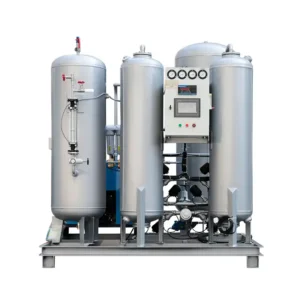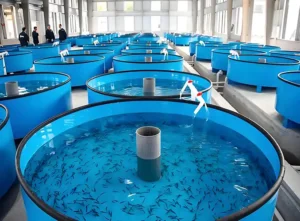
An oxygen generator for fish farming is an on-site system that extracts high-purity oxygen directly from ambient air and delivers it into aquaculture water to maintain optimal dissolved oxygen (DO) levels. Whether you manage a recirculating aquaculture system (RAS), open ponds, raceways, or hatcheries, choosing the right aquaculture oxygenation system can determine your stock survival, growth rate, and bottom-line profitability.
What Is an Oxygen Generator for Fish Farming and How Does It Work?
An oxygen generator for fish farming produces concentrated oxygen gas on demand, right at your facility, eliminating the need for delivered cylinders or liquid oxygen tanks.
Core Definition
The generator compresses atmospheric air, removes moisture and contaminants, then separates nitrogen and other gases from oxygen using specialized molecular sieve beds, resulting in oxygen that typically achieves 90–95% concentration.
The pure oxygen is then distributed through a network of diffusers or injectors to maintain ideal oxygen levels for aquatic life, with automated monitoring systems that continuously adjust output based on real-time demand.
PSA (Pressure Swing Adsorption) Technology
PSA is a highly effective technology that uses specialized adsorbents, often zeolite, to separate nitrogen from air. Ambient air is drawn in and filtered to remove dust, moisture, and contaminants, then passed through adsorbent materials that trap nitrogen and allow oxygen to pass through.
Key PSA specs at a glance:
- Oxygen purity: 90–95%
- Operating pressure: 100–120 psi (per Global Seafood Alliance data)
- Typical capacity range: 8–5,500 cubic feet per hour
- Best for: Small-to-medium fish farms, RAS facilities, hatcheries
VSA / VPSA (Vacuum Swing Adsorption) Technology
There are two common generation processes: VSA and PSA. PSA involves compressing air to 100–120 psi, while VSA generation happens at 10 psi or lower. As a result, VSA uses less power than a PSA unit producing the same amount of oxygen.
VPSA generators are effective for supplying high volumes of oxygen for large aquaculture, mining, and water treatment operations, offering benefits such as instant start-up, independent on-site supply, and lower operating costs compared to PSA-type generators.
Quick comparison table:
| Feature | PSA | VPSA / VSA |
|---|---|---|
| Operating Pressure | 100–120 psi | ≤10 psi |
| Oxygen Purity | 90–95% | 90–95% |
| Energy Efficiency | Moderate | Higher (lower power per unit O₂) |
| Capital Cost | Lower upfront | Higher upfront |
| Best Scale | Small–medium farms | Large-scale operations |
| Maintenance | Periodic sieve + compressor service | Blower + vacuum pump service |
| Humidity Tolerance | Requires air dryer | More resilient in humid environments |
How Oxygen Reaches Your Fish
A side stream of water from the tank, pond, or raceway is pumped at pressure through a venturi nozzle where oxygen from the generator is injected. This saturates the water, which is then distributed through high-velocity mixing nozzles along the bottom of the vessel. Flow can be manually regulated or automatically controlled using a DO analyzer and probe.
Why Your Fish Farm Needs an Oxygen Generator: Core Advantages and Business Value
The decision to invest in on-site oxygen generation directly impacts every financial and operational metric in your aquaculture business.
1. Dramatically Higher Dissolved Oxygen Levels
High-purity oxygen from a generator effectively increases the natural saturation limit in the water by a factor of four compared to aeration with ambient air alone.
This single factor unlocks a cascade of production benefits:
- Faster growth rates — Fish in oxygen-rich environments grow faster and convert feed more efficiently.
- Lower mortality — Consistently higher dissolved oxygen levels result in lower mortality and higher food conversion rates.
- Higher stocking density — With reliable oxygen on demand, farms can safely increase biomass per tank or pond, boosting output per square foot while maintaining water quality.
2. Improved Feed Conversion Ratio (FCR)
Fish utilize feed most efficiently when DO is optimal. Keeping DO in the ideal range during feeding windows supports improved FCR and reduces uneaten feed that can degrade water quality.
3. Superior Water Quality and Biofiltration Support
Nitrifying bacteria are oxygen-hungry. Stable oxygen flows support robust biofiltration, faster ammonia and nitrite conversion, and fewer water-quality swings — especially at high biomass.
4. Supply Independence and Cost Predictability
O₂ cylinders come with rental fees, minimums, fuel surcharges, and variable pricing. On-site generation converts a volatile supply chain cost into a predictable energy-based cost structure, often lowering total operating expenses over the life of the system.
5. Operational Simplicity and Safety
Managing cryogenic tanks or large cylinder inventories introduces handling risks, storage constraints, and delivery scheduling headaches. On-site generation reduces deliveries, on-site traffic, and manual cylinder change-outs.
6. Scalability for Future Growth
You can right-size a generator for today’s demand and add capacity as you grow. Modular systems make it easier to support phased expansions, seasonal peaks, or pilot programs.
Oxygen Generator for Fish Farming: Application Scenarios and Tailored Solutions
Different aquaculture systems have vastly different oxygen demands. Choosing the right oxygen generator for fish farming starts with matching the system to your specific operation type.
Recirculating Aquaculture Systems (RAS)
The main benefit of RAS is the ability to reduce the need for fresh, clean water while still maintaining a healthy environment for fish. To be operated economically, commercial RAS must have high stocking densities.
Why oxygen generators are critical for RAS:
- In a typical intensively loaded recirculating system, aeration or oxygenation failure can lead to a total loss of the fish crop in 30 minutes or less unless backup oxygen is provided.
- RAS facilities typically require DO levels of 7–12 mg/L to maintain fish health and support biofilter performance.
- Pure oxygen injection via cone or venturi systems achieves supersaturation that ambient air aeration cannot match.
Recommended setup: PSA or VPSA generator + liquid oxygen backup tank + automated DO control loop.
Open Ponds and Earthen Ponds
Pond systems face unique challenges with DO fluctuation — temperatures rise in summer, algal blooms crash oxygen at night, and sediment oxygen demand is high.
Oxygen concentrators are particularly useful when water temperature is high in summer and the capacity of water to hold dissolved oxygen is low.
Key parameters for pond oxygen generators:
- Target DO: ≥5 mg/L for warm-water species (tilapia, catfish, pangasius)
- Delivery method: Micro-bubble diffusers or venturi injectors
- Generator sizing: Calculate peak demand during hottest month at maximum stocking density
Flow-Through Raceways
With an onsite oxygen generator, you can inject high-purity oxygen into raceways. This provides significant productivity gains and reduces mortality risks caused by poor water quality.
Raceways for trout and salmon typically require DO of 6–8 mg/L or higher. Low-head oxygenators positioned between raceway stages are the most energy-efficient delivery method.
Hatcheries and Nurseries
Larval and juvenile stages are the most sensitive to DO fluctuations. Even brief drops below optimal levels can cause irreversible mortality.
- Target DO for hatcheries: 7–10 mg/L (species-dependent)
- Oxygen must be delivered gently — micro-bubble diffusers prevent physical stress on fry.
- Automated DO monitoring is non-negotiable at this stage.
Shrimp Farming
Dissolved oxygen management is the most important requirement of aquaculture pond water quality. DO concentration below 3 mg/L is stressful to shrimp.
Shrimp farms — especially intensive biofloc and super-intensive raceway systems — benefit significantly from pure oxygen supplementation during high-density production cycles.
Live-Haul Transport
During fish transport, maintaining DO in confined tanks prevents stress and mortality. You can reduce your live haul expenses by filling your own cylinders from an on-site generator.
How to Choose and Size an Oxygen Generator for Fish Farming: Step-by-Step Guide
Selecting the right oxygen generator for fish farming requires a systematic, data-driven approach. Guesswork leads to either undersized systems that starve your stock or oversized systems that waste capital.
Step 1: Calculate Your True Oxygen Demand
Calculate your true oxygen demand (kg/day) based on species, biomass, temperature, and feeding rate. Don’t guess.
Basic formula:
Daily O₂ Demand (kg/day) = Feed Rate (kg/day) × Oxygen-to-Feed Ratio
Typical oxygen-to-feed ratios:
| Species Group | O₂:Feed Ratio |
|---|---|
| Salmon / Trout (cold water) | 0.5–0.7 kg O₂ per kg feed |
| Tilapia / Catfish (warm water) | 0.4–0.6 kg O₂ per kg feed |
| Shrimp (intensive) | 0.6–1.0 kg O₂ per kg feed |
Important: Apply a safety factor of 1.5× to account for peak demand, equipment inefficiency, and seasonal temperature swings.
Step 2: Choose Your Technology (PSA vs. VPSA)
For starting out or moderate-density operations, a high-quality PSA oxygen generator is the ideal, cost-effective workhorse. For scaling up or demanding environments with large oxygen demand, a VPSA-based system presents a superior long-term investment.
Step 3: Evaluate Total Cost of Ownership (TCO)
Look beyond the purchase price. Consider energy consumption, expected maintenance intervals, and the proven lifespan of core components like the compressor and molecular sieve.
TCO comparison framework:
| Cost Factor | Liquid Oxygen | PSA Generator | VPSA Generator |
|---|---|---|---|
| Upfront capital | Low | Medium ($50K–$300K) | High |
| Per-unit O₂ cost | High (delivery + fuel surcharges) | Low (electricity only) | Lowest |
| Delivery logistics | Recurring | None | None |
| Maintenance | Minimal | Moderate | Low–Moderate |
| System lifespan | N/A | 10–15+ years | 15–20+ years |
| Scalability | Limited | Modular | Highly modular |
A PSA oxygen generator typically requires an upfront cost that can range from $50,000 to $300,000, depending on the system’s capacity and complexity.
Step 4: Assess Your Site Environment
Audit your environment — is your site coastal, humid, dusty, or subject to temperature extremes? Choose a machine built for that reality.
Key site factors to evaluate:
- Ambient temperature range (affects air density and sieve performance)
- Humidity levels (PSA requires air dryers; VPSA is more tolerant)
- Altitude (derate capacity by ~3% per 300m above sea level)
- Available electrical power (three-phase preferred for larger systems)
- Space constraints (containerized solutions available for tight or remote sites)
Step 5: Plan for Backup and Redundancy
The need for emergency backup is critical. Liquid oxygen can automatically back up a generator if power is lost or the unit loses capacity.
Best practice architecture:
- Primary: On-site PSA/VPSA generator sized for ~80% of peak demand
- Secondary: Liquid oxygen bulk tank for peak shaving and emergency backup
- Tertiary: Backup power generator with automatic transfer switch
- Monitoring: 24/7 DO probes + alarm system with SMS/email alerts
Oxygen Generator for Fish Farming: Industry Compliance Standards and Regulations
Compliance is where most competitors drop the ball. Understanding and meeting regulatory standards protects your investment, your stock, and your market access.
EPA Dissolved Oxygen Criteria
Generally, DO levels less than 5 mg/L are considered stressful for fish and levels less than 3 mg/L are too low to support fish. DO levels below 1 mg/L are considered hypoxic and usually devoid of life.
Species-specific DO targets (mg/L):
| Species | Minimum DO (Survival) | Optimal DO (Growth) | Stress Threshold |
|---|---|---|---|
| Atlantic Salmon | 6.0 | 8.0–10.0 | <6.0 |
| Rainbow Trout | 5.0 | 7.0–9.0 | <5.0 |
| Tilapia | 3.0 | 5.0–7.0 | <3.0 |
| Channel Catfish | 3.0 | 5.0–7.0 | <4.0 |
| Shrimp (L. vannamei) | 3.0 | 5.0–7.0 | <3.0 |
The amount of oxygen required depends on species, size, water temperature, and stocking density. Generally, the recommended range is 5–7 mg/L for most warm-water species and 6–8 mg/L for cold-water species.
ISO 15839 — Water Quality Monitoring Equipment
Buoy-type multi-parameter stations monitoring pH, conductivity, and dissolved oxygen in aquaculture should adhere to ISO 15839 and EPA standards for sustainable fish farming.
Your DO monitoring equipment must comply with ISO 15839 to ensure measurement accuracy and system reliability.
BAP and ASC Certification Requirements
If you sell into premium export markets (EU, North America, Japan), Best Aquaculture Practices (BAP) and ASC (Aquaculture Stewardship Council) certifications often require documented water quality management plans — including:
- Continuous DO monitoring records
- Emergency oxygenation protocols
- Regular calibration logs for DO sensors
- Environmental discharge compliance
Oxygen Equipment Safety Standards
- NFPA 99 governs oxygen system safety (applicable to PSA/VSA system design)
- CE / ISO 9001 certification for equipment manufacturing quality
- Proper ventilation in generator rooms (oxygen-enriched atmospheres are a fire hazard)
- Pressure vessel compliance per local codes (ASME, PED, or equivalent)
Frequently Asked Questions About Oxygen Generators for Fish Farming
Q1: How does an oxygen generator for fish farming actually work?
It compresses atmospheric air, removes moisture, and uses molecular sieve beds to separate nitrogen from oxygen. The resulting 90–95% pure oxygen is distributed through diffusers or injectors into your aquaculture water.
Q2: What dissolved oxygen level do fish need to grow properly?
The recommended range is 5–7 mg/L for most warm-water species and 6–8 mg/L for cold-water species.Salmon and trout may require 8–10 mg/L for optimal growth.
Q3: How much does an oxygen generator for fish farming cost?
A PSA oxygen generator typically requires an upfront cost ranging from $50,000 to $300,000, depending on capacity and complexity.Smaller units for pilot operations start lower. VPSA systems have higher upfront costs but lower long-term operating expenses.
Q4: Is on-site oxygen generation cheaper than buying liquid oxygen?
In most cases, yes. On-site generation converts a volatile supply chain cost into a predictable energy-based cost structure.Cost savings of 40–80% versus delivered liquid oxygen or cylinders are typical for medium-to-large operations.
Q5: What is the difference between PSA and VPSA oxygen generators for aquaculture?
PSA compresses air to 100–120 psi, while VSA generation happens at 10 psi or lower. VSA uses less power than a PSA unit producing the same amount of oxygen.PSA is better for smaller farms; VPSA excels at large scale.
Maximize Your Fish Farm’s Potential with the Right Oxygen Generator
Choosing the right oxygen generator for fish farming is one of the highest-impact operational decisions you will make. From boosting dissolved oxygen levels and reducing mortality to cutting supply costs by up to 80%, on-site oxygen generation delivers measurable returns across every aquaculture system type — RAS, ponds, raceways, hatcheries, and shrimp farms alike.
The key takeaways: size your system for peak demand, evaluate total cost of ownership (not just sticker price), always build in backup redundancy, and automate your DO monitoring. When you match the right PSA or VPSA technology to your specific species, scale, and environment, the payback period consistently falls within 8–14 months.
Ready to take the next step?
- 📖 Still in the research phase? Explore our related guides on dissolved oxygen management for aquaculture and RAS system design best practices to deepen your knowledge.
- 📋 Comparing solutions? Download our free Oxygen Generator Sizing Calculator & Comparison Worksheet to evaluate vendors side by side.
- 💬 Ready for a customized solution? Contact our aquaculture engineering team for a free, no-obligation site assessment and oxygen demand analysis tailored to your farm’s species, scale, and growth plans.
Last updated: March 2026. This guide is periodically reviewed and updated to reflect the latest industry standards, pricing data, and technology developments.