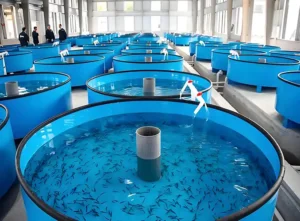
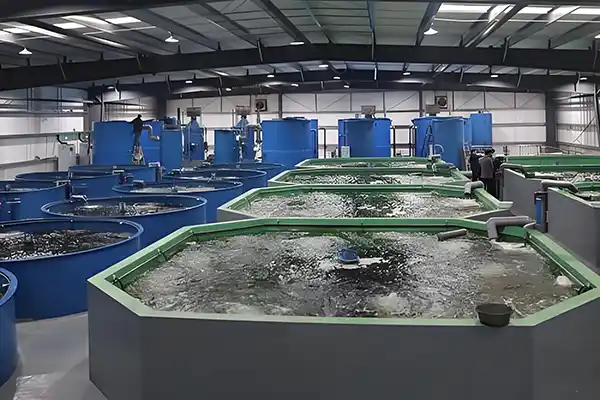
Ozone acts as a powerful oxidant in a recirculating aquaculture system (RAS), where it disinfects water, breaks down dissolved organic matter, improves water clarity, and promotes healthier fish growth. Ozone is used in RAS as a disinfectant, to remove organic carbon, and also to remove turbidity, algae, color, odor and taste. With over a decade of hands-on experience designing ozone integration for commercial RAS facilities across freshwater and marine operations, we have seen ozone consistently outperform chemical alternatives in water quality management.
In this guide, you will learn exactly how ozone works inside a RAS, the correct dosing ranges, safe ORP thresholds, freshwater vs. saltwater considerations, potential risks, and practical sizing recommendations. Whether you manage a salmon smolt facility or a shrimp hatchery, this article answers every critical question so you can make confident engineering and purchasing decisions.
How Does Ozone Improve Water Quality in a RAS?
Ozone delivers measurable water quality improvements that mechanical filtration alone cannot achieve. Conventional means of solids removal, such as microscreen filters and sedimentation tanks address the removal of coarse settleable and filterable solids, but not the removal of fine colloidal solids.
Here is what ozone does that standard filters miss:
• Breaks down dissolved organic matter (DOM): The accumulation of dissolved organic matter (DOM) can have detrimental effects on water quality impacting the system performance, microbial community, and consequently fish health and welfare. Ozone is used in the RAS water treatment process to improve water quality and remove DOM.
• Reduces TSS and BOD: Low-dose ozonation resulted in significant reductions in TSS, biochemical oxygen demand, and true color of the culture water.
• Eliminates water color: The most profound effect was diminished color, which was otherwise observed as tea-colored turbidity resulting from dissolved organic matter.
• Oxidizes dissolved metals: Ozone also reduced dissolved metals, including copper, iron, and zinc concentrations.
• Oxidizes nitrite to nitrate: In freshwater RAS, previous research has also indicated that ozonation can improve water quality by improving microscreen filter performance, breaking refractory compounds and thereby eliminating the accumulation of water color, and oxidizing nitrite to nitrate.
Does Ozone Kill Pathogens in a RAS?
Yes. Ozone can effectively inactivate a range of bacterial, viral, fungal and protozoan fish pathogens. However, complete disinfection inside RAS loop water is rarely the goal.
Unlike potable water or pharmaceutical applications, RAS does not require ozone at disinfection or sanitation levels. Instead, the goal is to reduce pathogens and organic load, not eliminate them entirely.
Key takeaway: Low-dose ozone reduces pathogen pressure while preserving beneficial biofilter bacteria. Pairing ozone with UV irradiation delivers the strongest disinfection results. When ozonation was followed by UV irradiation, total heterotrophic bacteria counts and total coliform bacteria counts were reduced to 0–4 cfu/mL and 0–3 cfu/100 mL respectively. Combining ozone dosages of only 0.1–0.2 mg/L with a UV irradiation dosage of approximately 50 mJ/cm2 would consistently reduce bacteria counts to near zero.
Does Ozone Improve Fish Growth in a RAS?
Yes. Research from the Conservation Fund Freshwater Institute confirms it. This research found that rainbow trout grew significantly faster in low exchange RAS (~7-day HRT) operated with ozone compared to trout raised in similarly operated RAS without ozone.
Cleaner water means less gill irritation, lower stress, and better feed conversion ratios — all directly linked to faster growth.
What Is the Correct Ozone Dose for a RAS?
Dosing depends on two primary variables. Proper ozone dosing depends mainly on two key variables: water recirculation rate and daily feed rate.
Here are the industry-accepted reference ranges:
| Parameter | Freshwater Finfish | Crustaceans |
|---|---|---|
| Ozone per flow rate | 0.1–0.3 mg/L | 0.1–0.3 mg/L |
| Ozone per feed | 12–16 g O₃/kg feed | Up to 25 g O₃/kg feed |
| Contact time | 1–3 minutes (side-stream) | 1–3 minutes (side-stream) |
As a general guideline, ozone dosing typically ranges from 0.1 to 0.3 mg/L based on flow rate. Ozone demand is approximately 12 to 16 grams of ozone per kilogram of feed. For crustacean species, this can rise to 25 g of ozone per kg of feed.
These are approximate values; actual dosing will depend on factors such as system design (raceway, RAS, or hybrid), water temperature, and species-specific requirements.
How Do You Monitor Ozone Levels in a RAS?
ORP (Oxidation-Reduction Potential) probes are the standard method for continuous in-flow monitoring. A common way of providing some level of continuous in-flow monitoring for ozone is the use of oxidation-reduction potential (ORP) probes.
Safe ORP setpoints for freshwater RAS:
• Target range: 300–320 mV at the tank inlet
• Auto-shutoff trigger: ≥ 320 mV
Oxidation reduction potential (ORP) – an indirect measure of ozone residual – is monitored via a differential sensor positioned at the tank inlet. Millivolt readings from the ORP probe are received by a digital control system that is integrated within an on/off feedback loop. When an upper ORP setpoint is reached (typically 300-320 mV), one of two strategies are employed to maintain a safe ORP level in the fish culture environment.
Important: Due to the lack of direct measurement of ozone and because ORP probes can take several minutes to register a change in ORP, any use of ORP to measure and control ozone application is approximate. For this reason it is recommended that ozone control using ORP measurements allows for some error and limits are set conservatively.
What Are the Risks of Using Ozone in a RAS?
Ozone is a powerful tool but carries real risks if mismanaged. Understanding these risks is non-negotiable before system integration.
Can Ozone Harm Fish?
Yes. Higher ozone concentrations are a risk to cultured fish stocks causing gross tissue damage and stock mortalities, and also are a risk to bacterial films on the biofilter.
Ozone is reported to be toxic to a wide range of fresh and salt-water organisms at residual concentrations between 0.01 ppm and 0.1 ppm.
Species-specific sensitivity examples:
| Species | Harmful ORP / TRO Threshold |
|---|---|
| European sea bass | > 320 mV in tanks |
| Atlantic salmon (brackish) | > 350 mV |
| Atlantic halibut | ~330 mV / 16–23 µg/L Cl₂ |
For European sea bass in RAS, the ORP should not exceed 320 mV in the tanks. Ozone doses higher than 350 mV resulted in significant mortality in salmon.
Is Ozone Safe in Saltwater RAS?
Extra caution is required. Ozone reacts with bromide and chloride ions in saltwater to produce relatively stable oxidants that are toxic to aquatic organisms.
These toxic by-products include bromate and bromoform. Use of ozone in saltwater systems is usually restricted to batch treatment of water separate to the main recirculating flow.
Mitigation strategies:
• Use side-stream batch treatment — keep ozonated water separate from the main loop
• Install activated carbon filtration — Activated carbon filtration can be used to remove residual ozone and other oxidants from ozonated saltwater.
• Monitor ORP strictly — When treating seawater, ORP should be carefully monitored. Exceeding 800 mV of ORP can oxidize bromide ions into bromine, which is toxic to aquatic species.
Ozone can be used in seawater and brackish water systems. However, its application is safer in freshwater where the primary reaction by-product is oxygen.
Does Ozone Damage Biofilters in a RAS?
It can, if residual ozone reaches the biofilm. Overdosing can harm fish, damage gills, or interfere with beneficial biofilters.
Low-dose ozone applied upstream — with proper ORP-controlled shutoff — avoids biofilter damage. In fact, ozone supports biofilter performance by reducing the organic load that competes with nitrifying bacteria. In a RAS, this pre-oxidation reduces the organic load reaching the biofilter, which promotes the activity of nitrifying bacteria and improves the overall efficiency of biological filtration.
How Is Ozone Delivered Into a RAS?
Various methods are used to transfer ozone to RAS water, including sidestream contact chambers, fine bubble diffusers, and combined use with foam fractionation.
The three most common delivery methods:
| Method | Best For | Notes |
|---|---|---|
| Venturi injector (side-stream) | Most RAS designs | High mass-transfer efficiency |
| Fine bubble diffuser | Contact tank applications | Good dissolution in large volumes |
| Low head oxygenator (LHO) | Full-flow treatment | Pioneered by Freshwater Institute |
The Conservation Fund Freshwater Institute (FI) has developed a different approach, where ozone is added alongside the primary oxygen gas within a low head oxygenator. With this method, the entire RAS flow is ozonated just before water returns to the fish tank.
What Type of Ozone Generator Works Best for Aquaculture?
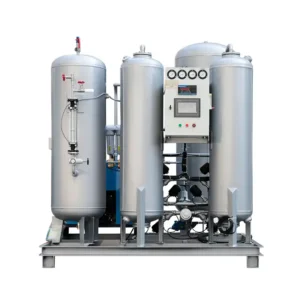
Corona discharge generators using oxygen feed gas are the industry standard. Commercial systems primarily use corona discharge technology, which passes dried air or pure oxygen through a high-voltage electrical field. This splits oxygen molecules (O₂) and recombines them into ozone (O₃). Corona discharge generators produce ozone concentrations of 1–12% by weight.
Oxygen-fed generators produce 2–3 times more ozone per unit of energy compared to air-fed systems.
For sizing, use the feed-to-ozone ratio as your starting baseline. Achieving these water quality control benefits required the addition of only 15-25 g of ozone (O₃) for every kilogram of feed fed to the recirculating system.
What About Worker Safety Around Ozone in a RAS Facility?
Ozone is hazardous to human health at very low airborne concentrations. The 8-h human exposure limit for airborne ozone gas established by OSHA is just 0.1 ppm, and the 15-minute exposure limit is only 0.3 ppm.
Mandatory safety measures:
• Install ambient ozone gas sensors in all enclosed areas
• Set alarm triggers at 0.1 ppm and auto-shutoff at 0.3 ppm
• Equip generator rooms with dedicated exhaust ventilation (minimum 6 air changes/hour)
• Install thermal or catalytic destruct units on all off-gas lines
• Use ozone-compatible materials only: 316 stainless steel, PTFE, PVDF
It’s highly recommended that RAS facilities utilizing ozone install and maintain ambient ozone sensors, alarms, and remote generator shut-off systems to ensure worker safety.
5 Common Mistakes When Using Ozone in a RAS (And How to Avoid Them)
Most RAS operators understand the benefits of ozone. Far fewer understand the pitfalls. Here are the mistakes we see most frequently across client projects:
Mistake #1: Treating Ozone Like a “Set and Forget” System
Ozone demand changes constantly with feed rates, stocking density, temperature, and organic load. A static dosing approach leads to under- or over-treatment.
Fix: Use ORP-controlled feedback loops. Calibrate ORP probes weekly. Cross-reference ORP readings with nitrite and turbidity data.
Mistake #2: Ignoring Saltwater By-Products
Many operators apply the same ozone protocols to saltwater as freshwater. Ozonation of estuarine (brackish) or marine waters can produce different by-products oxidants and significant amounts of TRO which is highly toxic for aquatic organisms, i.e., bromate, bromoform, etc.
Fix: In marine or brackish systems, restrict ozone to batch-treated side-streams. Always pair with activated carbon post-treatment.
Mistake #3: Oversizing the Ozone Generator
Bigger is not better. Oversized generators waste energy and increase the risk of accidental overdosing.
Fix: Size your generator based on the feed-to-ozone ratio (12–25 g O₃/kg feed, depending on species). Start conservative. Scale up based on ORP and water quality data.
Mistake #4: Skipping UV Post-Treatment for High-Dose Applications
Research indicated that a relatively strong ozone dose to achieve > 375 mV ORP could be applied to RAS water when followed by UV irradiation levels sufficient to destroy residual ozone before water returned to the fish tank.
Without UV, residual ozone at those levels would damage gills and kill fish.
Fix: If your disinfection strategy requires ORP above 320 mV, install UV irradiation downstream. Budget for the additional energy costs.
Mistake #5: Neglecting Operator Training
Ozone generation technology is relatively complex and requires trained fish culture personnel and maintenance staff that are capable of effective operation, maintenance, and equipment repair.
Fix: Train every team member on ozone safety protocols, emergency shutoff procedures, and routine probe calibration. Document SOPs and review them annually.
Frequently Asked Questions About Ozone in RAS
Q1: How long does ozone last in RAS water?
Ozone has a short half-life, typically ranging from six to 20 minutes, depending on water temperature and organic load. In practice, ozone reacts almost immediately with organics. Contact time in side-stream applications is typically just 1–3 minutes.
Q2: Can ozone replace UV in a RAS?
Not entirely. Ozone excels at oxidizing organics and micro-flocculation. UV excels at pathogen inactivation without chemical residuals. Combining ozonation and UV irradiation can effectively disinfect recirculating water before it returns to the fish culture tank(s). The combination is superior to either method alone.
Q3: Does ozone remove off-flavors like geosmin and MIB from RAS water?
Low-dose ozone did not significantly reduce common off-flavor (geosmin and MIB) levels in RAS water or rainbow trout flesh. However, ozone can indirectly help by oxidizing precursor organic compounds before bacteria convert them into off-flavor molecules.
Q4: What happens to ozone after it reacts in water?
Ozone decomposes into pure oxygen, leaving no toxic residue, making it the most sustainable solution for aquaculture disinfection and water quality control. In saltwater, however, oxidant by-products (bromate, bromoform) may persist and require removal.
Q5: How much does an ozone system cost for a RAS facility?
Costs vary widely based on capacity. Industrial aquaculture ozone generators range from several thousand dollars for small hatcheries to six figures for large commercial operations. RAS facilities must consider the water quality and fish performance benefits that ozone provides along with capital (ozone generators, monitoring systems) and operating (energy, oxygen) costs, and the associated risks to employee and fish health.
Q6: Is ozone safe for shrimp farming in RAS?
Yes, with careful dosing. In shrimp farming, ozone is increasingly used as a replacement for chlorine, particularly in areas where electricity is cheaper than chemical supply chains. It is also effective against recurrent viral diseases such as White Spot Syndrome. Use seawater by-product precautions at all times.
Conclusion:Make Ozone Work Smarter in Your RAS
Understanding what ozone does in a recirculating aquaculture system (RAS) is the first step toward better water quality, healthier fish, and a more profitable operation. From pathogen reduction and organic matter oxidation to micro-flocculation and nitrite control, ozone delivers proven results — but only when dosed correctly, monitored continuously, and supported by proper system design.
If you are evaluating ozone generators, ORP controllers, or complete water treatment solutions for your RAS facility, explore our [ozone system product line →] or [request a free consultation →] with our aquaculture engineering team. We help facility managers select the right equipment, size the system accurately, and commission it safely.